
You dream of a smooth, durable, spotless epoxy garage floor. However, if you’re planning on starting over that old concrete floor soaked with decades of motor oil and coolant, stop!
Experts will tell you that when applying a coating to your garage floor (whether it’s epoxy, polyurethane, or polyaspartic), degreasing and surface preparation are far more important than the actual painting . If oil, grease, or any other contaminant remains trapped in the concrete’s pores, your expensive coating will flake and crack like a sticker as traffic passes over it, effectively ruining the original finish.
In this guide, we’ll break down a professional-grade deep cleaning and surface preparation process to ensure your coating mechanically bonds to the old floor, rather than just floating on the surface.
Phase 1: Extracting dirt – from adsorption to decomposition
Before any cleaning agents are introduced, the excess, uncured oil must be “pulled” from the tiny pores of the concrete.
Clean up loose materials and absorb residual grease
Don’t underestimate simple cleaning; loose dust and grit must be removed thoroughly.
Clear the battlefield: Remove all tools, vehicles, and storage racks.
Hard Cleaning: Use an industrial vacuum (Shop Vac) or a stiff bristle broom to remove all dust and debris.
Use absorbents: For heavy or old oil stains, sprinkle a generous amount of cat litter (choose non-clumping type), diatomaceous earth, or fine sawdust.
Tip: Use the sole of your shoe or a push brush to vigorously grind the absorbent into the stain, giving it time (overnight is best) to absorb the penetrating oils.
Sweep or vacuum every other day to remove any adsorbents.
Deep Degreasing: Why You Can’t Use Regular Cleansers
Kitchen cleaners or soap-based products will leave a filmy residue on the surface that is the enemy of coating adhesion. You must use a specialized concrete degreaser .
Choose the right chemicals: Use a strong, biodegradable degreaser like professional-grade products like “Simple Green” or “Oil Eater.” These are designed to break the chemical bond between grease and concrete.
Pay attention to environmental protection and safety: Many professional cleaning agents, such as trisodium phosphate (TSP) , are powerful but corrosive. Always wear gloves and goggles when handling and follow local environmental disposal regulations.
Spot and systemic treatments: Pour degreaser (concentrated or diluted as needed) directly onto stubborn stains and scrub vigorously with a stiff-bristled brush .
Keep wet and repeat: Let the degreaser sit for 10-20 minutes ( key: don’t let it dry! ), constantly stirring it in with your brush. For older, dark stains, you may need to repeat the full degreasing process two or three times.
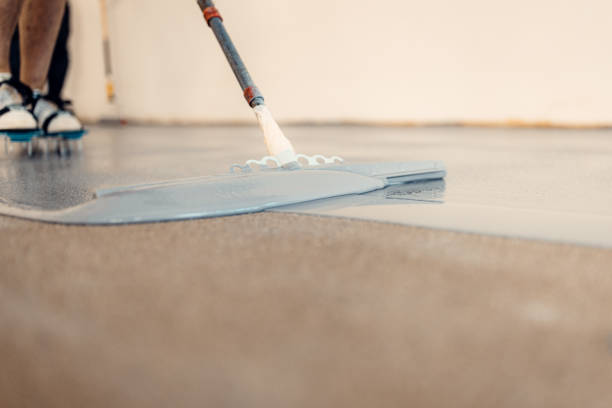
Phase 2: Creating the profile – making the coating “grab” the ground
Even if the floor appears clean, its surface may still be as smooth as glass, making it impossible for coatings to adhere. We need to “open” the pores of the concrete, a process called “surface profiling.”
Option A: Chemical etching
Acid etching is an inexpensive and common DIY surface roughening method.
Prepare the etchant: Use a commercial concrete etchant (most commercially available products are based on diluted citric or hydrochloric acid).
Application and Reaction: Apply the etchant evenly to the wet floor. You will see bubbles appear on the surface, which is evidence that the acid is eating away at the concrete.
Rinse and Neutralize (Critical): Rinse thoroughly after allowing the coating to sit. The most important step is neutralization. Use water with a small amount of baking soda or ammonia to give the floor a final rinse to neutralize any residual acid. Acid residue is another common cause of coating failure.
Option B: Mechanical Grinding – Professional First Choice
For old floors that have been severely oiled for many years, chemical etching is often inadequate. Mechanical grinding is the preferred method for professionals .
How it works: A professional grinder with a diamond grinding wheel is used to physically grind away a thin layer of oil and old coating contaminated on the concrete surface, revealing the clean, rough, porous concrete underneath.
Bond Guarantee: This method creates the best possible bond profile (typically CSP 2-3 ), completely eliminating all contaminant and moisture issues and providing the greatest possible assurance that the coating will not peel.
Stage 3: Waiting for Drying – The Final Test Before Success
This is the most patience-testing step, but one that absolutely cannot be compromised. The coating system requires a completely dry surface in order to cure and bond.
Waiting time: Depending on weather and humidity, it may take 24 to 72 hours , or even longer.
Humidity test (can’t skip!):
Tape an 18×18 inch piece of plastic wrap (such as a garbage bag) to the ground.
Check after 24 hours: If condensation appears under the membrane, or the concrete in that area has darkened, keep waiting! Any moisture can cause the coating to blister and peel.
Speed it up: Use a high-powered fan or dehumidifier to speed up air movement and moisture evaporation.
Summarize:
Cleaning an old garage floor that’s heavily greasy isn’t a one-time scrubbing exercise, but a layered peeling process: first remove surface dirt, then use a degreaser to break down the grease, and finally open the concrete pores by acid etching or grinding.
If you’re going to use a high-performance polymer coating, remember: degreaser is your old friend, high-pressure washing is your bodyguard, and ample drying time is your final judge.
Your next car, or your next garage project, will be riding on a solid, beautiful, professionally prepped surface.
When you last did some DIY work in your garage, which step was the most frustrating? Do you prefer etching yourself or paying someone to grind it mechanically? Share your experience in the comments!
