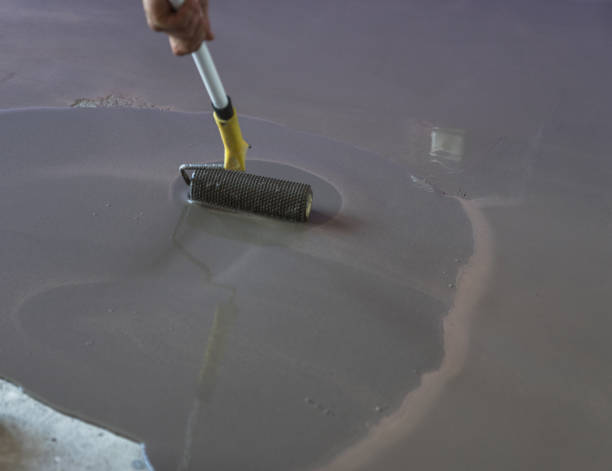
If you have completed the basic work of the floor: the primer provides perfect adhesion , and the base coat lays beautiful colors . But please understand: what really determines whether your floor will yellow, wear out or leave permanent stains in the next ten years is the final thin “protective cover” – the clear topcoat .
The clearcoat is the layer in the entire flooring system most susceptible to wear and UV damage, making its material selection crucial. This article will delve into the scientific advantages and selection criteria of the two major clearcoat materials used in professional flooring systems— polyurethane and polyaspartic— and how to achieve maximum durability.

1. Four core functions of transparent topcoat: Guardian of the floor
Think of the clearcoat as a combination of “bulletproof vest” and “sunscreen” for your flooring system.
Function 1: Anti-ultraviolet and anti-yellowing
Pain Point Solved: Traditional epoxy-based color coats (even high-quality 100% solids epoxies) will yellow in sunlight . This chemical degradation causes the floor color to change from gray to a disgusting amber or yellow.
Topcoat Protection: Clearcoat must have an aliphatic structure to effectively resist UV degradation. The clearcoat acts as a “sunscreen,” absorbing and scattering UV rays through its stable molecular structure, thereby protecting the underlying color layer from sunlight.
Function 2: Extreme wear resistance
Principle: The clearcoat is the layer that directly bears daily wear and tear from tires, tool friction, shoe soles, and dragging furniture. High-quality topcoat has a higher cross-linking density and Shore hardness .
Professional Standards: Professional clearcoat materials are often tested using the industry-standard Taber abrasion test to quantify their wear resistance. This abrasion resistance is often several times greater than that of the base epoxy layer and is a key indicator of durability.
Function three: resistance to chemicals and stains
Principle: Varnish can provide a dense, non-porous surface barrier to prevent the penetration and retention of corrosive chemicals such as motor oil, fuel, automotive fluids, de-icing salt, etc. Epoxy floors without varnish can easily be permanently “branded” by tires or oil stains.
Function 4: Gloss and Texture
Aesthetics and safety: The topcoat determines the floor’s final aesthetic (gloss, matte, or satin). Meanwhile, for safety, anti-slip aggregates (typically fine aluminum oxide) must be precisely integrated into the clearcoat to control the coefficient of slip (COF) and ensure the floor remains safe when wet.
2. The two clearcoat kings: polyurethane vs. polyaspartic acid
In the world of professional flooring, choosing a varnish is often a game of either or.
Polyurethane varnish: the reliable balancer
Features: Provides excellent wear resistance, impact resistance and good chemical resistance . It has a certain degree of flexibility , can withstand daily impact and temperature changes, and is not easy to crack.
Disadvantages: Relatively long cure times (typically 24-72 hours before return to service). Some solvent-based polyurethanes may contain high VOCs and may be difficult to apply in extremely low or high humidity.
Polyaspartic varnish: a beast of speed and performance
Features:
Extremely fast curing: The biggest advantage is that it often cures within 1-4 hours, greatly reducing downtime and is very suitable for commercial projects or cold climate construction.
Excellent flexibility: It has extremely high flexibility, super wear resistance and excellent chemical resistance.
Ultimate UV Resistance: Widely regarded as the best material for resisting yellowing, it can withstand decades of direct sunlight without discoloring.
Disadvantages: The initial cost is the highest; the working time is very short (maybe only 10-20 minutes), and the construction workers are required to have a high level of experience, which is not suitable for DIY beginners.
3. How to choose your floor “sunscreen”: varnish selection criteria
Before you decide on a clearcoat type, ask yourself three questions:
Judgment 1: Ambient Lighting: If your garage door is often open, or if there are large windows that expose the garage to direct sunlight, you must choose polyaspartic acid . This is the best insurance against UV rays.
Judgment 2: Speed of application (downtime): If you need to be back in service within 24 hours (or in a commercial environment), polyaspartic acid is the only choice.
Judgment three: budget and degree of wear: If it is a low-traffic home garage and the UV requirements are not high, high-quality aliphatic polyurethane is a more economical and well-balanced option.
in conclusion :
The clear topcoat is the final and most critical line of defense for your epoxy flooring system. While the primer ensures adhesion, the topcoat determines how long your floor will remain beautiful and how much wear and tear it can withstand.
Never compromise on your clearcoat. Whether it’s polyurethane or polyaspartic, make sure you choose a high-performance, aliphatic, high-solids clearcoat . This is the only way to maximize your flooring investment’s UV and wear resistance , and it’s key to upgrading your garage from an ordinary space to a long-term asset.
If you had to choose between speed and cost, which would you sacrifice to get a better clearcoat? Share your flooring investment philosophy in the comments!
